APHERISFOLD
Co-folding models that hold up on your targets.
ApherisFold runs OpenFold3, Boltz-2 and Protenix-v1 inside your own environment. Teams benchmark them against their own resolved structures, fine-tune them on proprietary structural data, and use the result in live programs. Structures, sequences and queries stay in your infrastructure.

WHAT IT DOES
Benchmark, fine-tune and run on your own data.
A published benchmark score says little about how a model behaves on the targets in your portfolio. ApherisFold lets teams measure that on their own structures, adapt the model where it falls short, and run the result in their programs.
Benchmark on your ground truth
Compare OpenFold3, Boltz-2 and Protenix-v1 on your own held-out structures, with pose validity checks and a metrics suite, so you know where each model is reliable before you rely on it.
Fine-tune to your targets
Prepare ML-ready training data, run reproducible fine-tuning experiments, and evaluate the result against base or federated checkpoints using the same benchmarks.
Run it in your workflows
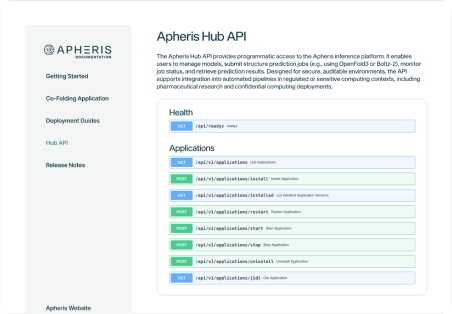
Inspect predictions in a 3D interface, or call inference, benchmarking and fine-tuning through the API and integrate results into screening, design and prioritisation pipelines.
WHO USES IT
Two ways to work with co-folding models.
Computational teams integrate ApherisFold into their pipelines. Medicinal chemists work in the interface. Both use the same models, the same benchmarks and the same deployment.
For integration into your pipeline
Run inference, benchmarking and fine-tuning through the Hub API, and pull results into screening, design and prioritisation pipelines.

For exploring in the interface
Submit predictions, review poses in the 3D viewer against a reference structure, and compare runs on computed metrics.

EVIDENCE
Ten structures were enough to fix the binding pose.
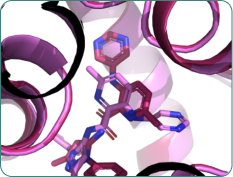
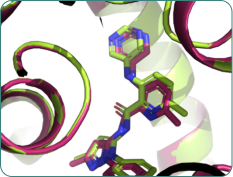
We fine-tuned OpenFold3 on ten human phosphodiesterase 10 structures. Out of the box the model placed the ligand poorly. After fine-tuning it recovered the pose, and improved across metrics on seventeen held-out structures it had never seen.
The run took twenty hours on a single H100, under a hundred dollars of compute, which is within reach for a program team to repeat as new structures arrive.
10
training structures
17
held-out structures
<$100
compute per run
Two further case studies, a VHL-CDO1 molecular glue ternary complex and a JAK2 macrocycle series, are covered in the resources below.
HOW TEAMS USE IT
Most organisations run both a global and a program-level model.
Fine-tuning on proprietary data is done two ways. A global model trained across targets and programs gives breadth. A program-level model trained on target-specific data gives accuracy on binding pose and local SAR. Most organisations need both.
Globally fine-tuned model
Trained on internal data across targets and programs. Lower operational overhead, centrally governed, and consistent across teams. Broader coverage of targets and scaffolds.
Best for early discovery, target triage and portfolio-wide screening
Program fine-tuned model
Trained on target and compound-specific data, experimental or synthetic. Higher accuracy on binding pose and local SAR, and able to return a conformation that is rare in the global model.
Best for lead optimisation and late-stage series work
Proprietary protein-ligand structures – data of unprecedented size and diversity
Secure, federated computing technology to enable collaboration
Advancing co-folding and building a new capability for pharmas
APHERISFOLD AND FOUNDRY
ApherisFold is the co-folding application on Foundry.
ApherisFold covers the co-folding work itself, prediction, benchmarking and fine-tuning, in a browser interface built for it. Foundry is the platform it runs on. That is what makes the same tasks callable from your own pipelines, and what connects ApherisFold to models trained across the Apheris networks.
Start from a network-trained model
Members of an Apheris network can start from a model fine-tuned across proprietary pharma structures rather than a public checkpoint. Network membership is not required to use ApherisFold.
The same tasks, callable anywhere
Structure prediction, affinity prediction, data preparation and fine-tuning are Foundry tasks. Use them in ApherisFold, or call them from your own DMTA tooling.
One security review
ApherisFold runs on the same deployment as the rest of Foundry, so your IT and security teams review it once.
MODELS AND TASKS
Compare OpenFold3, Boltz-2 and Protenix-v1 on the same targets.
OpenFold3, Boltz-2 and Protenix-v1 are all available, so teams can compare them on the same targets and datasets rather than committing to one architecture. All prediction tasks can be used for lead optimisation and virtual screening.

Members of an Apheris network can run the network-trained models here as well, and compare them against the open-source checkpoints on their own targets.
WHERE IT BREAKS
Performance depends on how close your target is to the training data.
Co-folding models have improved, but accuracy still tracks similarity to what the model saw in training. In a drug program that shows up as unreliable predictions on exactly the targets, conformations and binding modes you care about.
Novel targets or ligand chemotypes
When a complex differs significantly from structures seen in training, models often fail to predict an accurate binding pose.
Under-represented protein conformations
If a ligand binds a conformation that is rare in public data, the model may return a more common but incorrect one.
Large or complex assemblies
Predictions become less reliable for multimers and complexes with large sequence sizes.
Allosteric binding sites
Models favour orthosteric binding modes because those dominate structural databases.
Each has a practical mitigation in ApherisFold, from fine-tuning on related structures and templating to give the model wider context, to constraints around a known binding site or starting from a network-trained model.
WHY IT MATTERS NOW
Co-folding is changing how DMTA decisions get made.
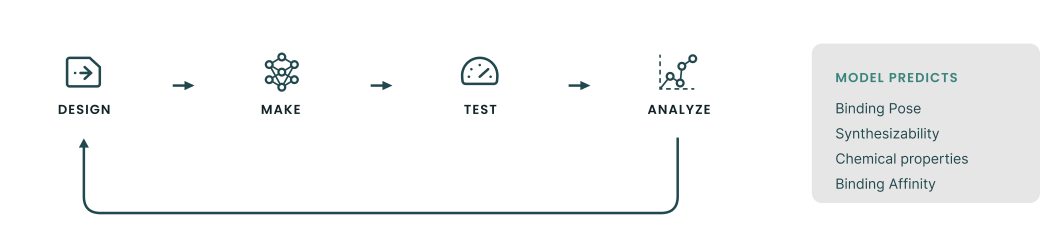
Predictions are now reliable enough to act on before an experimental structure exists. That makes workflows practical that were not before, including virtual screening, hit prioritisation, structure-based affinity prediction and generative design against novel targets.
Virtual screening
Score large virtual libraries against a target before committing to synthesis.
Hit prioritisation
Rank hits on predicted binding mode, not just on a docking score.
Affinity prediction
Structure-based affinity estimates to guide lead optimisation.
Generative design
Design new binders for novel targets against specific objectives.

DEPLOYMENT
Deployed in your own infrastructure.
ApherisFold deploys on-premises, in your private cloud or into a Kubernetes cluster, as containers you pull and run. It integrates with your existing SSO and MSA services. All data, inference queries and outputs remain inside your infrastructure.
Runs where you choose
On-premises, private cloud or Kubernetes, using container images and your existing cluster processes.
Fits your identity stack
Integrates with your SSO, and with local or precomputed MSA services.
Nothing leaves
Structures, sequences, queries and outputs stay inside your environment.
GETTING STARTED
We run the first fine-tune with you.
A useful fine-tune depends on how the data is split, which hyperparameters are chosen and how the result is evaluated. Our scientists work through the first cycle with your team, then hand it over.
STEP 1 DAYS
Clarify the setup
Which structures and targets, what the evaluation set looks like, and how MSAs are handled. We bring best practice on data splits and hardware.
STEP 2 DAYS TO WEEKS
Prepare the data
Your data goes through the ApherisFold preparation pipeline and comes out ML-ready, split into training and validation sets.
STEP 3 HOURS TO RUN
Run the fine-tuning
Fine-tuning experiments with hyperparameter suggestions from us, and an early read on validation performance.
STEP 4 ONGOING
Evaluate and deploy
Review predictions visually and on computed metrics, then pick the model your programs will use.
FAQ
Frequently asked questions about ApherisFold.
FIRST CONVERSATION
What happens when you reach out.

Neann Mathai
Scientific fit, assessment of what’s realistic on your data, as well as ongoing program management

Alex Binnie
Model behaviour on your targets, benchmarking and the fine-tuning plan
Your first conversation is with Neann and Alex, both of whom work on co-folding with customers. It is a technical discussion about your targets, not a sales call.
GET STARTED
See ApherisFold on your own targets.
Tell us which targets your team is working on and we will go through how ApherisFold would benchmark and fine-tune against them. Deployment runs inside your environment, so your IT and security teams can be involved from the start.