APHERIS FOUNDRY

Turn foundation models into program-specific drug discovery engines

Foundry takes any model (open-source, partner, or trained across an Apheris network) and enables your teams to fine-tune and benchmark it on your proprietary data, then apply it to your programs through workflows. Network membership is not required. All of it runs inside your own environment, so no data or model ever leaves it.
THE PROBLEM

Even the best model is generic until you make it yours.

However good the starting model, whether open-source or trained across an Apheris data network, it has not seen the programs that define your edge: your novel targets, proprietary scaffolds and assay data. That is where predictions are most useful, and where an uncustomized model is least reliable. Foundry customizes any model on your data and embeds it into your drug programs.

HOW IT WORKS

Customized on your data, embedded in your workflows.

STEP 1

Benchmark, then choose your starting model.

Compare candidates (open-source foundation models, partner models, or for network members one trained across an Apheris network) against your own held-out data and chemical space, so the model you build on is the one that performs on your problem, not the one that tops a public leaderboard.

STEP 2

Fine-tune it on your data.

Fine-tune the model on your own structures, assays and other program data, so it learns the chemistry and the targets that define your edge.

STEP 3

Run it where your science happens.

Use it for a single prediction or chain a full workflow end to end, through code, an interface, or an agent, all on your own infrastructure so your data and models never leave.

Every result feeds back in, so the model keeps improving on your programs.

WORKFLOWS

Turn model predictions into program decisions.

Tasks are the modular building blocks of Foundry, each built for a specific purpose: data preparation, structure prediction, affinity prediction, fine-tuning. A workflow chains them together to tackle one problem end to end. Models return predictions; Foundry turns those predictions into decisions your teams can act on.

Structure and binding.

Predict how a molecule binds and rank candidates, so screening focuses on what is worth making.

SAR and selectivity.

Explain why potency moves across a series and flag off-target risk before you commit to synthesis.

Properties and developability.

Coming soon

Anticipate ADMET and developability liabilities early, so fewer candidates fail late.

Foundry is modular.

Run workflows inside Foundry, or call individual tasks from your own DMTA tooling so the models reach your teams where they already work. You can bring your own models and tasks in as well, and compose workflows of your own.

ACCESS

Three ways to use it.

Foundry meets each part of your team where they already work.

Programmatic (CLI and API)

The main computational entry point. Run tasks and workflows programmatically, and integrate them directly into your existing DMTA tooling.

Agents

Every task and workflow is accessible agentically, so your teams can compose and run them from the tools they already use.

Graphical interface

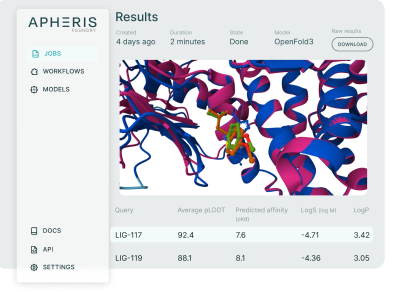
Launch and review workflows in the browser, for scientists who prefer to work visually, or who do not work in code.

SECURITY AND IP

Runs where your data is. Your IP stays protected.

Foundry is one platform, deployed in your environment. Whether you run an open-source model, your own, or one trained across an Apheris network, the guarantee is the same: your proprietary data never leaves your control.

Deployed in your own infrastructure.

Foundry is deployed inside your own infrastructure. Proprietary structures and assay data never leave your environment, and both customization and inference run locally.

Your queries stay private.

Because Foundry runs locally, no third party ever sees what you run. The targets and series you probe never leave your environment.

Your data is never exposed or reused.

Apheris never accesses or sees your data, and never uses it to train models for anyone else. It stays in your environment, and you control which computations run against it.

Federated models, without shared data.

Some models Foundry serves are trained across an Apheris network. That improves a collaborative model from many organizations without any raw data being exchanged: each partner keeps its data in its own environment and only model updates are combined.

Deploy Foundry in your own Kubernetes cluster or virtual machine, or, for teams that prefer no infrastructure, let Apheris host and manage it.

A neutral operator.

Apheris is a technology partner and network operator, not a competing drug developer, so we have no conflict of interest with your programs.

Our controls are independently validated through recognized certifications and testing.

WORKING WITH APHERIS

Foundry is the product our federated networks run on, delivered with forward-deployed scientists.

Our federated networks run on Foundry.

A model is only the start. Our forward-deployed scientists work side by side with your computational chemists: your team knows your drug programs best, and ours knows how to customize the models and get the most out of them. Together, that turns AI into real value across your DMTA cycle.

DOCUMENTATION

Everything Foundry does is documented in the open.

Tasks, workflows, the CLI, the API and deployment requirements are all public. Your computational and platform teams can see exactly what Foundry does, and what it needs from your infrastructure, whenever it suits them.

Tasks and workflows

Every task Foundry ships: what it takes as input, what it returns, and how tasks compose into a workflow.

CLI and API reference

Command structure, configuration, output contracts and exit codes: what a platform team needs to integrate Foundry into existing pipelines.

Deployment and requirements

Standalone containers or a Kubernetes cluster, GPU requirements per task, and the network conditions Foundry needs.

FAQ

Frequently asked questions about Apheris Foundry.

FIRST CONVERSATION

What happens when you reach out.

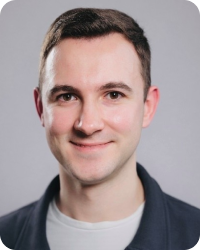
Julian Schönauer

Commercial fit, engagement model, next steps.

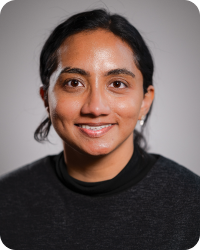
Neann Mathai

Scientific fit, benchmarking, what is realistic on your data.

Your first conversation is with Julian and Neann, one on commercial fit, one on the science. It is a focused, technical discussion about your programs, with the goal of understanding where you are and whether Foundry can help.

1

Understand your situation.

We talk through your programs, your data, and where your current models fall short.

2

Find where we can add value.

Together we identify the workflow or decision where a customized model would move the needle, and what improvement is realistic.

3

Scope a pilot.

If it fits, we define a focused pilot on one active program: one question, a measurable target, and a path to scale.

GET STARTED

Bring Foundry into your programs.

The fastest way to see value is on an active program. Tell us what you are working on, and we will come back with a focused pilot: one question, a measurable target, and a path to scale.

You will hear back from Julian and Neann directly.