RESOURCE LIBRARY
From federated models to drug discovery decisions
Research, product releases, and technical deep-dives on federated AI for co-folding, ADMET, and antibody developability.

ADMET liabilities drive 40–45% of clinical attrition, and models break on novel chemistry which is precisely where chemists need them most. Pre-competitive federated networks address this through complementary data collaboration. A walk through the evidence behind the Apheris ADMET Network.

GEN published a thoughtful coverage of last month's Bio-IT World plenary keynote where JT from Apheris presented a session on federated learning and fine-tuning for drug discovery.

We rebuilt the SandboxAQ affinity head inside ApherisFold and fine-tuned it on 49 JAK2 macrocycles. Architectural changes alone lifted Spearman ranking from 0.418 to 0.60; fine-tuning then pushed validation Pearson from 0.23 to 0.76, mostly by correcting how the model handled inactives.

Federated techniques such as federated learning and federated analysis have emerged as a powerful paradigm for enabling multi-center research on sensitive clinical data while preserving patient privacy. In this study we provide a federated leraning framework for ML research.

A new agentic AI application aims to speed up drug development, helping bring new medical treatments to patients faster.

Delivering a state-of-the-art federated co-folding model across five pharma companies in record time

Co-folding models help lead optimization by predicting binding modes, filtering weak candidates before synthesis, and improving compound prioritization through benchmarking, fine-tuning, and expert review.

Protenix-v1, a fully open co-folding model reporting AlphaFold3-level performance under matched conditions, is now available in ApherisFold. Teams can run and benchmark it locally on proprietary datasets, compare it to OpenFold3 and Boltz-2, and evaluate performance within real DMTA workflows.

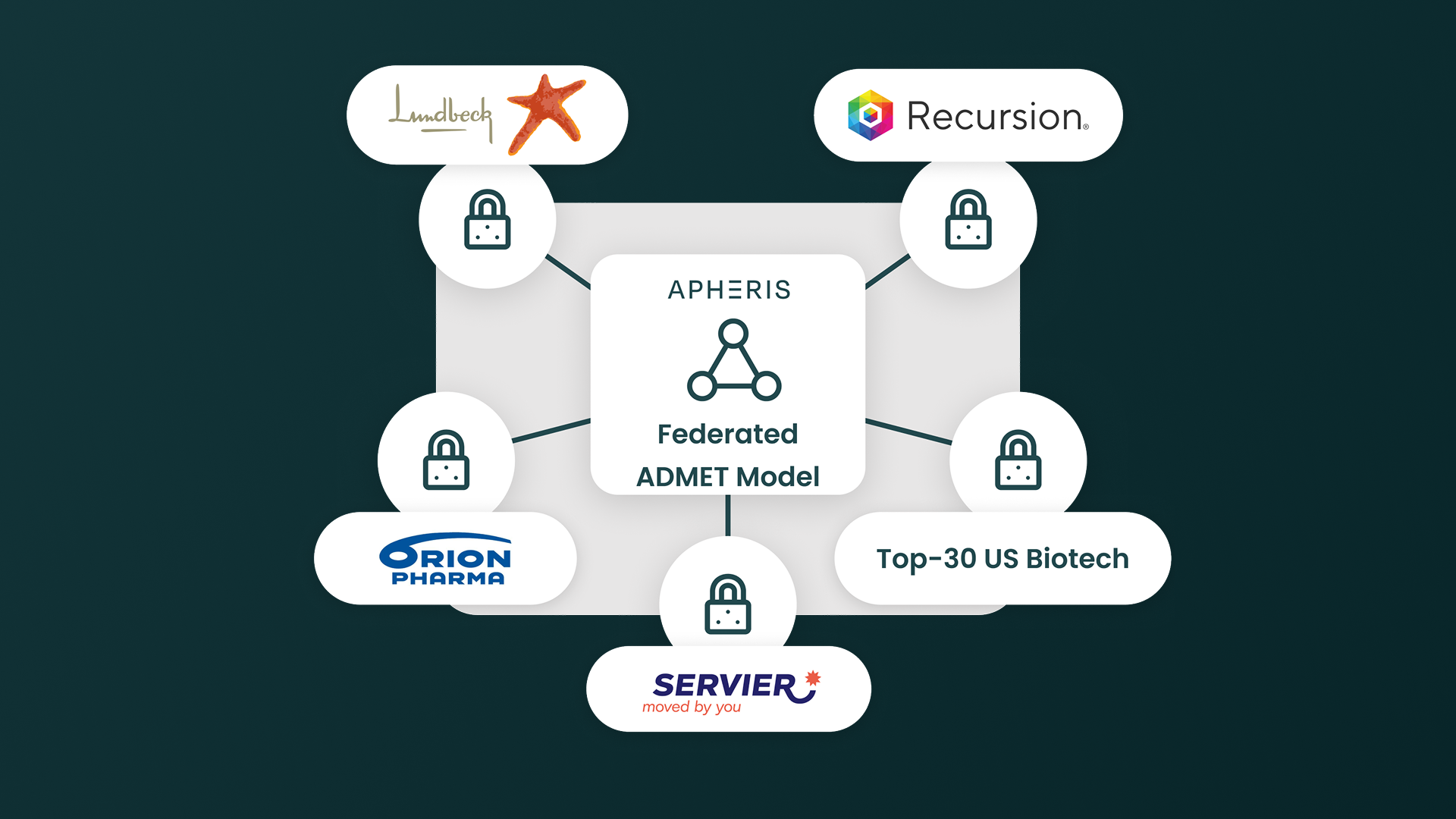
Apheris's ADMET Network will combine proprietary datasets in a privacy-preserving environment to accelerate AI drug discovery models

Founding members include Lundbeck, Orion Pharma, Recursion, and Servier, among other pharma and biotech companies

Using a recent J. Med. Chem. TrmD study, we evaluate how well OpenFold3 protein–ligand co-folding recovers binding modes and key interactions, and where it can realistically support medicinal chemistry decisions.

We fine-tuned OpenFold3 on just 10 PDE10A protein–ligand complexes and evaluated on 17 held-out structures. Even this low-n setup corrected systematic pose errors and improved interface metrics, making predictions more usable for design decisions.

Improved ADMET predictions come from complementary chemistry, not sheer data volume. A scientific study of public–proprietary integration shows why diversity, balance, and harmonization matter for reliability, calibration, and broader model applicability.

Co-folding models perform well on benchmarks but struggle on novel targets. Real impact comes from building internal capabilities: benchmarking on proprietary data, fine-tuning where needed, and extending generalisability. Read Robin Röhm's IPT piece to learn more

This blog explores state-of-the-art science in ADMET prediction, showing how federated learning enables pharma companies to collaboratively train models on diverse data, achieving higher accuracy and broader applicability without compromising data privacy.

We tested how well OpenFold3 predicts a novel protein–ligand complex by reproducing a SIK3–inhibitor complex and analyzing its selectivity over AMPK. Using ApherisFold, we accurately replicated the experimental ligand pose and could rationalize the observed selectivity through steric effects.

Apheris, a leading provider of AI applications for drug discovery, today announced the launch of ApherisFold, an enterprise software product that enables pharmaceutical organizations to securely run, benchmark, and fine-tune the latest co-folding models, including OpenFold3 and Boltz-2, directly within their own IT environments.
Apheris shares insights from federating large protein models, OpenFold3 and Boltz-1, on NVIDIA DGX Cloud with NVFLARE. The results show that with the right setup, federated learning can match centralized training—enabling secure, collaborative AI in drug discovery.

AI methods often rely on limited public datasets, restricting industrial impact. Federated learning enables secure collaboration across private pharma data, but data access remains a major challenge.

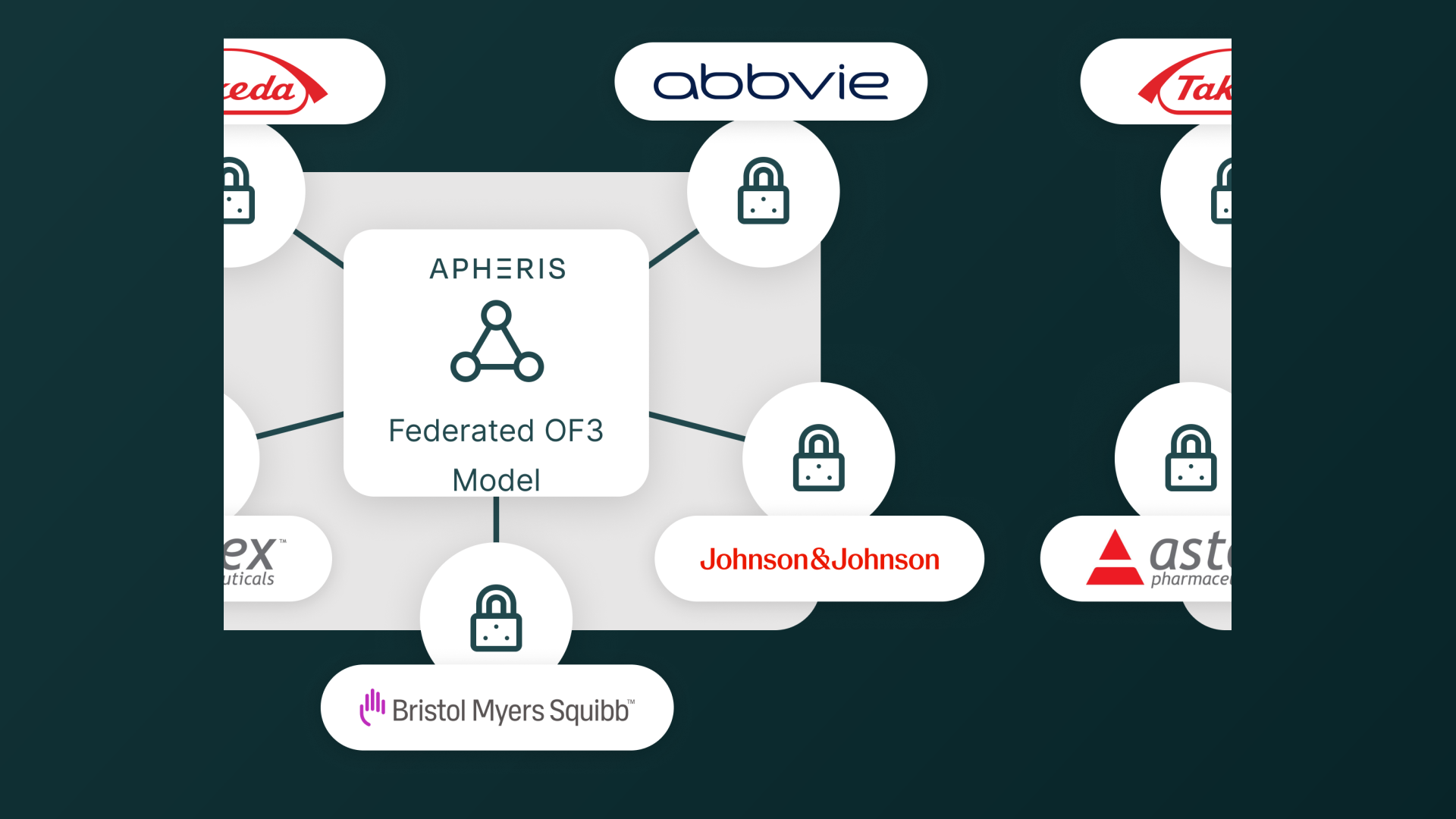
Apheris announced today the expansion of the Federated OpenFold3 Initiative from the AI Structural Biology (AISB) Network.

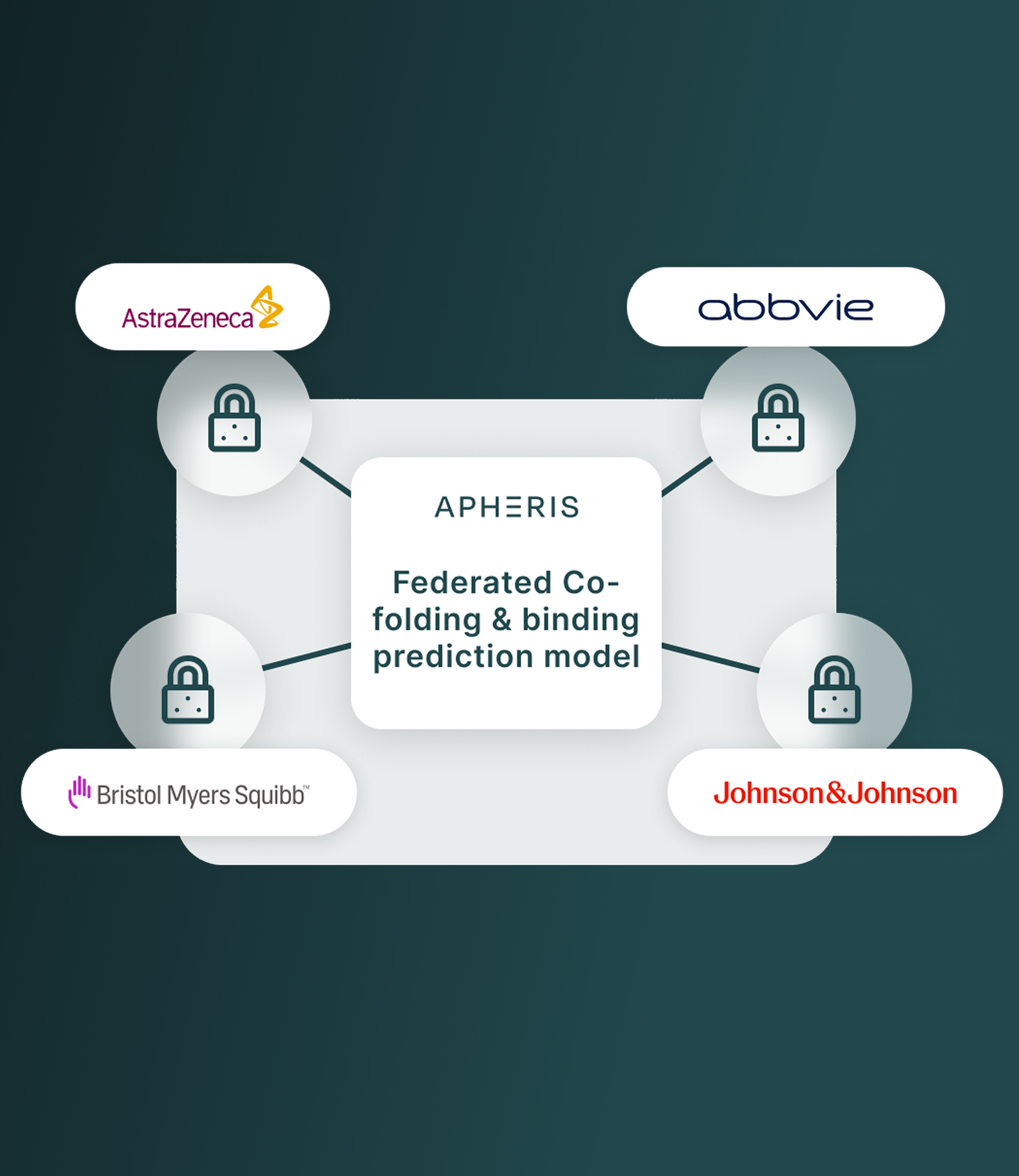
The AI Structural Biology (AISB) Network, powered by Apheris GmbH, has expanded its Federated OpenFold3 Initiative with the addition of Astex Pharmaceuticals, Bristol Myers Squibb, and Takeda. The new partners join founding members AbbVie and Johnson & Johnson to fine-tune OpenFold3 on proprietary structural datasets.

Co‑folding models, like AlphaFold 3, Boltz‑2, and OpenFold3, can predict the joint 3D structures of two (or more) molecules at the same time. While these models perform well on public benchmarks, they often become less accurate when applied to novel targets underrepresented in the training data.

In this proof-of-concept work, we aim to apply and adopt Federated Learning (FL) in a real-world hospital setting. We assessed FL for MS lesion segmentation using the self-configuring nnU-Net model, leveraging 512 MRI cases from three sites without sharing raw patient data.

Ginkgo Bioworks today announced a series of new initiatives from its Datapoints offering to accelerate the application of artificial intelligence in biologics drug discovery. These include a strategic partnership with Apheris to launch the Antibody Developability Consortium and, separately, the AbDev AI Competition.

In collaboration with AWS, we implemented FRA-LoRA (Full Rank Aggregation of Low-Rank Adapters) in a federated setting to fine-tune ESM-2 across multiple sites, all without sharing raw data. LoRA reduced trainable parameters to <2% of the original model, cutting communication overhead while preserving accuracy.

Apheris will bring privacy-preserving, AI infrastructure and collaboration on proprietary data to the OpenFold Consortium

In the ever-evolving landscape of drug discovery, understanding how a drug behaves in the body is crucial. In this blog, Dr Angelo Pugliese explores the pivotal role ADMETox plays in this process.

AbbVie, J&J to add proprietary data to AIprotein model in bid to accelerate drugdiscovery. OpenFold3 will access the companies’ data using federation technology from Apheris

In a new initiative by the AI Structural Biology (AISB) Consortium and powered by Apheris, OpenFold3, a protein structure prediction algorithm developed by the lab of Mohammed AlQuraishi, will be fine-tuned using proprietary data from AbbVie and Johnson & Johnson.

OpenFold3, a structure prediction system developed by AlQuraishi Lab at Columbia University, will be fine-tuned using proprietary data from AbbVie and Johnson & Johnson in a confidentiality-preserving and secure federated environment powered by Apheris.

The Apheris Platform enables multiple organisations to extract value from each other’s decentralised data sets and overcome regulatory, technical, and commercial challenges.

Berlin 09.03.2025 - Apheris has successfully completed SOC 2 Type II attestation, confirming that our controls for data protection, security, and privacy adhere to recognized industry standards.

Seed extension round led by Octopus Ventures to drive growth of platform enabling organizations to unlock terabytes of valuable data risk-free

Certification highlights our mission and focus on best practices for federated machine learning and analytics, enabling organizations to securely build and operationalize machine learning and data applications across boundaries.
Apheris achieves SOC 2 Type I attestation, reaffirming its commitment to data security and privacy, and the comprehensive measures we have implemented to protect sensitive information and ensure the highest level of security.

The Apheris Trust Center serves as a comprehensive resource for organizations seeking to uphold the highest standards of security and data privacy. It offers guidance and our certifications and attestations, including ISO 27001 and SOC 2, that customers value as essential components to fulfil their compliance obligations.

Thousands of 3D protein structures locked up in big-pharma vaults will be usedto create a new AI tool that won’t be open to academics.

Fine-tuning large language models requires high computational and memory resources, and is therefore associated with significant costs. When training on federated datasets, an increased communication effort is also needed. For this reason, parameter-efficient methods (PEFT) are becoming increasingly important.

Apheris raises Series-A with leading European investors. OTB is leading the round in collaboration with eCAPITAL.

We discuss the real-world application of federated learning (FL) in the healthcare and life sciences industry, noting a tipping point in its adoption beyond academia.

We are excited to announce that Apheris has officially joined the Global Alliance for Genomics & Health (GA4GH) as an organizational member.

Open-source frameworks for federated learning are a great way of getting first hands-on experience. Here are our Top 7 with their respective pro and cons

Ellie Dobson, VP Product at Apheris, discusses how the rapid adoption of ML has led to data becoming one of the most valuable assets in business. However, for use cases where compliance with regulation and data privacy is of paramount importance, unlocking the full potential of data raises unique challenges.