ADMET NETWORK

ADMET models you can trust on novel chemistry

Federated models trained on proprietary data from across the industry, then fine-tuned on your chemistry and run inside your own environment. Built for pharma and biotech teams running ADMET across a portfolio of discovery programs.

WHY THE ADMET NETWORK

Better ADMET models than any company can build alone.

Calibrated ADMET models on novel chemistry, built on complementary industrial data and kept fully private.

Broader applicability domain

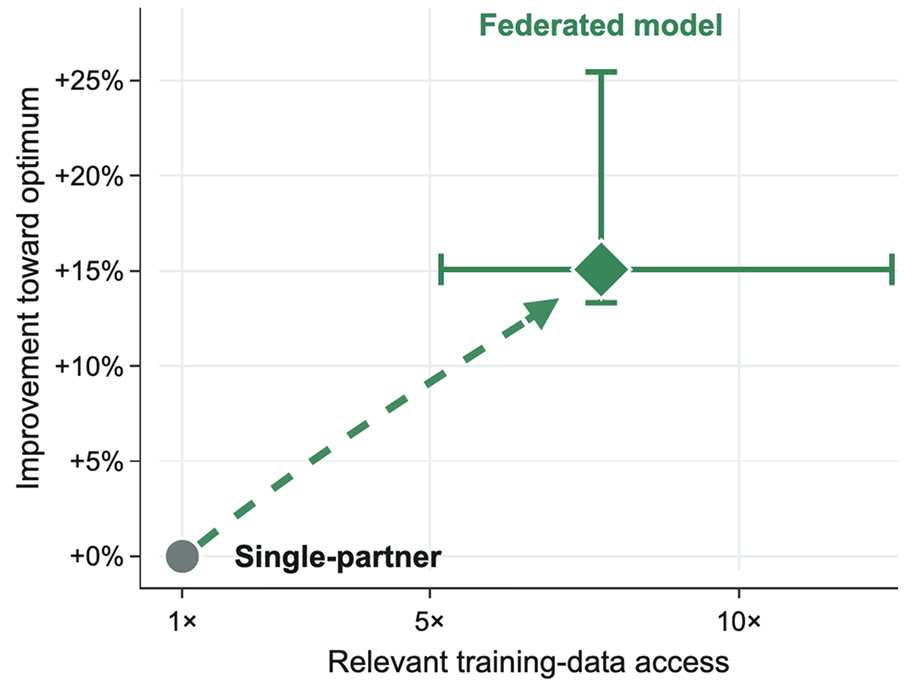
Leverage complementary industrial ADMET data far beyond your own assays.

Earlier signal on ADMET risk

Drop weak series sooner with better-calibrated predictions and uncertainty on novel chemistry.

Faster, better-informed DMTA cycles

Design more informative batches and use experimental capacity better.

Your data never leaves

Collaborate without sharing a single molecule. Raw data and IP stay in your environment.

Trained and retrained across the industry’s combined ADMET data, historical and newly generated. Models run inside your environment. Your compounds and queries are never sent to another company’s platform. Members co-own the resulting models and fine-tune them on their own chemistry.

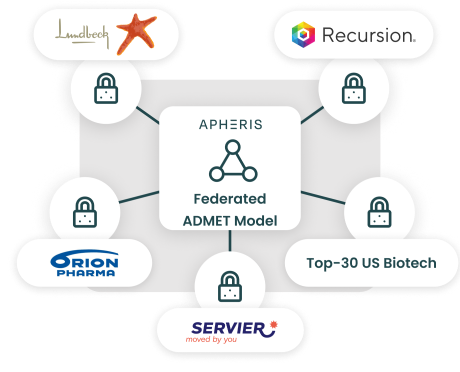
Founding members collaborate on their proprietary ADMET data without sharing it.

Models are trained collaboratively with data staying local, and the benefits are shared among contributors. The network is open to new members.

RESULTS FROM FEDERATED TRAINING

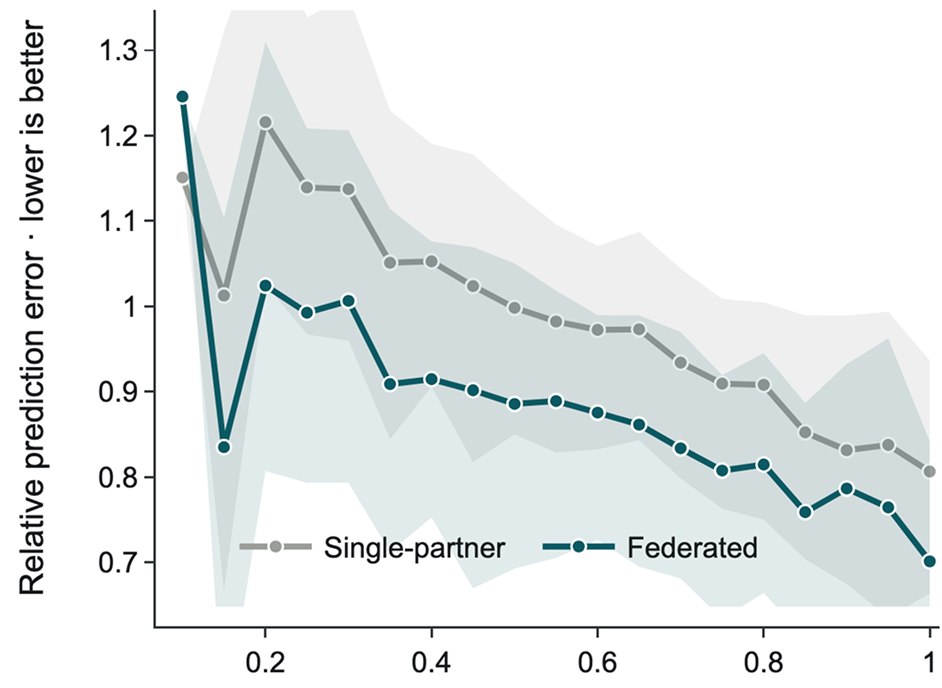
Federated training beats the in-house baseline.

The numbers below come from the latest benchmarking. The dataset keeps growing as partners generate new data, so these are a floor rather than a ceiling.

900,000+

proprietary compound-activity measurements across 700 tasks, used for training and never pooled

5

pharma and biotech founding members, with two more onboarding

~26%

higher mean Pearson correlation across endpoints

28 endpoints

trained endpoints pushed past the usability bar, which partners could not model reliably on their own

Mean Pearson correlation across endpoints

+0.093 uplift

Evidence of federated superiority, with positive bootstrap support. The gains land most where relative ranking and prioritization matter.

“In therapeutic areas such as CNS, early discovery decisions are shaped by complex ADMET considerations. The ADMET Network enables more confident decision-making by improving how models generalize to novel chemistry, beyond what can be learned from a single organization’s experience alone.”

Paul Kilburn

Senior Director, Medicinal Chemistry and Translational DMPK, Lundbeck

Trained across the industry, without moving a molecule.

The ADMET Network trains a shared trunk across every member’s proprietary data, where that data already lives, and repeats as new data arrives.

  1. Start from a strong public base.
    A multi-task graph neural network (ChemProp), pre-trained on 55+ ADME tasks curated from public data.
  2. Train locally, inside each member’s environment.
    Training runs inside each member’s own environment. Only model weights leave; the data never does.
  3. Aggregate into a network model.
    Weights combine into a shared model, tested against data-reconstruction and membership-inference attacks before release.
  4. Fine-tune and run in your environment.
    Each member fine-tunes on their own portfolio and runs it locally. Fine-tuned models and queries stay private.
  5. Improve as new data arrives.
    Newly generated data is folded in as it arrives, so the model keeps improving rather than aging.

Members control exactly what runs on their data.

ENDPOINT COVERAGE

20+ endpoint categories today, and expanding.

The network already spans more than 20 endpoint categories across the properties that drive early optimization, and continues to expand. Within a category, partners often run several distinct experiments under different conditions, species or matrices. Each of those is a separate endpoint in training, which is why the number of trained endpoints is higher than the number of categories listed here.

Physicochemical

LogD

LogP

Aqueous solubility

Biorelevant solubility

Absorption & permeability

Caco-2

MDCK-MDR1

MDCK-BCRP

PAMPA

P-gp efflux

Distribution

Plasma protein binding

Brain tissue binding

Blood-to-plasma ratio

Metabolism

CYP 1A2

CYP 2C9

CYP 2C19

CYP 2D6

CYP 3A4

Microsomal stability

Intrinsic clearance

Whole blood stability

Reactive metabolite screening

Cardiac safety

hERG liability

Coming next

In vivo PK

Off-target activity

DILI

DDIs

Mitochondrial toxicity

DELIVERED INTO YOUR ENVIRONMENT

Put the models to work in your programs.

The network models are delivered into your own environment. You fine-tune them on your portfolio and run them at scale.

Run where your data is.

Models are deployed inside your own infrastructure. Predictions and the compounds you query never leave it.

Fine-tune on your chemistry.

Adapt the network model to your own compounds and assays. Fine-tuned models stay private to you.

Integrate into your workflows.

Reach models through a UI, an API, or your own agents, and connect them to the tools your teams already use.

Run at production scale.

Score millions of compounds through infrastructure built into your discovery loop.

Run models locally, benchmark on in-house data, and review predictions in the browser. Securely, inside your environment.

Customized to each drug program.

The network model is the starting point. Each program fine-tunes it on its own compounds and assays, so predictions reflect the chemistry your team is working on right now.

Predictions land where the decisions happen, in design and triage, for computational and medicinal chemists alike.

NETWORK OVERVIEW

The full picture, in one document.

How the ADMET Network trains its models, what it covers, and how member data and IP stay protected at every step.

Inside:

  • The end-to-end workflow, from data preparation through federated training and privacy assessment to local fine-tuning
  • The full endpoint list and how the scope is expanding
  • Latest benchmarking results
  • What leaves a member’s environment, what never does, and the controls in between
Download the overview

FAQ

Frequently asked questions about ADMET.

What happens when you reach out.

Lewis Mervin

Principal Machine Learning Engineer

Julian Schönauer

Senior Director, Commercial & Operations

Your first conversation is with Lewis and Julian, one on the science, one on how the network runs. It is a technical discussion about your endpoints and your data, not a pitch.

1

Scientific onboarding.

We answer your remaining scientific and modelling questions, walk through the benchmarks, and share our data preparation guides so your team can see exactly what is involved.

2

Technical and InfoSec review.

You start your security review using our Trust Center and product documentation, and we share the IT questionnaire needed to prepare deployment.

3

Contracting.

We work through the MSA and order form together. A letter of intent can be signed beforehand if you need to move in stages.

All three can run in parallel.

JOIN OUR NETWORK

Join the Federated ADMET Network

Every partner who joins adds signal that lifts the models for everyone. A first conversation covers your endpoints, your data, and what joining would involve. You will speak directly with the team that runs the science and the network.