FEDERATED RWE NETWORK
Run multi-site RWE studies on patient data that never leaves the hospital.
Cohort identification, imaging-derived endpoints, progression modelling and external control arms, computed inside each site under its own governance.

FEDERATED RWE NETWORK
Cohort identification, imaging-derived endpoints, progression modelling and external control arms, computed inside each site under its own governance.
WHAT YOU CAN RUN
Every one of these executes on patient-level data inside the hospital that holds it. Only approved, aggregated outputs come back.

Imaging-derived endpoints for trials
Automated lesion quantification, for example in multiple sclerosis, computed site by site and usable as a surrogate endpoint in a trial.

Cohort identification at scale
Find patients with a specific disease phenotype across hospitals, for trial recruitment and to construct external control arms.

Disease progression modelling
Track lesion change longitudinally across institutions, using the same definitions and the same pipeline at every site.

Multi-site validation of digital biomarkers
Validate an imaging biomarker across diverse patient populations, scanners and protocols, instead of a single cohort.
STUDY DESIGNS
The two designs an RWE lead asks about first, and what the network contributes to each.

Comparative effectiveness
Compare treatment strategies across hospital populations. The same analysis runs at every site and only aggregate results are returned.

External control arms
Build a matched control cohort from real-world patients where a randomized arm is not feasible, drawing on more than one institution.

Longitudinal follow-up
Follow the same patients over time at the site that holds their record, so progression is measured rather than inferred.
WHY RWE STALLS
The constraints in today’s RWE setups that a federated network is built to remove.

Patient data sits across hospitals and partners
The data needed for multi-site studies stays inside each site’s own environment.

Data protection rules limit cross-site use
GDPR, site governance and contractual constraints restrict how studies can run across institutions.

Every study becomes a new coordination effort
Approvals, legal review and technical setup are repeated site by site, so site relationships never turn into scalable studies.
WHAT CHANGES
Infrastructure and governance are deployed once per collaboration. Studies run on top of that, one after another.

Run studies with less setup
Deploy once per collaboration, then stop repeating approvals, legal review and technical onboarding for every new study.

Broader clinical data under site control
Analyze hospital-held patient data while each site keeps control of its own data, policies and environment.

Go beyond predefined datasets
Traditional agreements limit researchers to fixed extracts or narrow scopes. Federated computing runs analysis directly on site-held data.
GOVERNANCE AND COMPLIANCE
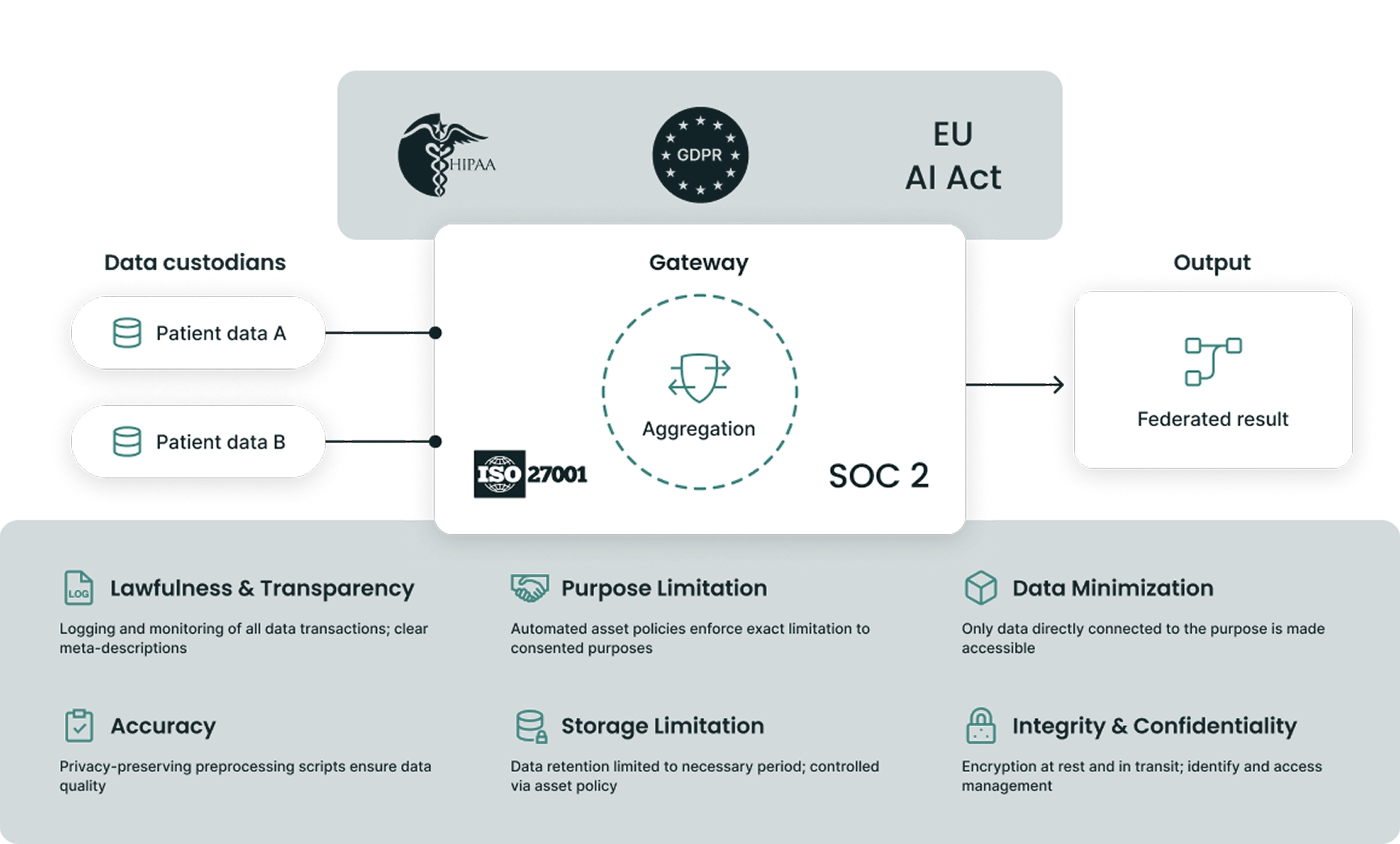
Privacy is handled by the architecture rather than case by case.

Data stays inside each site
Patient data remains within each site’s environment, so studies run across institutions without transferring or centralizing anything sensitive.

Simpler ethics board approvals
Privacy is addressed upfront in the architecture and governance is deployed once per collaboration, reducing repeated approvals and contracting effort.

Analysis on granular data
Instead of predefined extracts or aggregated tables, analyses run directly on site-held records.
A neuroscience network across more than 50,000 patients.
Apheris powers a multi-site data network built to study disease progression on real-world patient data. It connects data from multiple hospitals covering more than 50,000 patients, including EHR, imaging and other patient-level data.
Pharma teams run statistical analysis, machine learning and imaging AI directly at each site, without moving patient-level data. That is what makes cross-site study on real-world patients possible under strict data protection and governance requirements.


“Working in partnership with Apheris adds new data analytics capabilities within the TriNetX industry leading global federated real‑world data network. This makes it possible to support a broader range of global advanced analytics and machine learning workflows on site-held patient data while maintaining privacy-preserving computational governance. Additionally, our partners can connect their own data to the TriNetX data network without moving any data.”
Steven Kundrot
Chief Operating Officer, TriNetX
FAQ
Frequently asked questions about RWE.

Evelyn Trautmann
Lead Research Engineer. Technical design of the federated analysis and what actually runs at each site.

Lukas Pluska
Senior Manager, Life Sciences. Study scope, site engagement, and how a collaboration is set up.
Your first conversation is with Evelyn and Lukas, who work on federated RWE with hospitals and pharma teams. It is a technical discussion about your sites and your study, not a sales call.
1
Understand the study
We talk through the study you want to run, the sites you work with, and the endpoints or cohorts it depends on.
2
Map the data and the governance
We look at what each site holds, what its policies allow, and what has to be true for the analysis to run locally.
3
Scope the first deployment
We scope the one-time infrastructure and governance setup, then the first study that runs on top of it.
GET STARTED
Tell us which sites you work with and which studies you want to run, and we will go through how the network would be set up. Everything executes inside each site’s own environment, so clinical, IT and legal teams keep control.
